New Requirements for Large Energy Consumers in Mexico: What Companies Need to Do Now
Mexico has introduced new requirements for large energy consumers that will affect how qualifying facilities register, report energy information, and manage energy performance.
 The Energy Planning and Transition Law (Ley de Planeación y Transición Energética, or LPTE), published in March 2025, and its regulations, published in October of that year, established a new framework for energy management and compliance in Mexico. Under this framework, energy management systems (EnMS) play a central role for large energy consumers, with ISO 50001 serving as the reference standard for implementation.
The framework took a significant step forward on October 1, 2026, when new rules governing the Registration of High Energy-Consumption Pattern Users (Usuarios de Patrón de Alto Consumo, or UPAC) and the implementation of EnMS came into effect. The rules were published in Mexico’s Federal Official Gazette (Diario Oficial de la Federación, or DOF) the previous day.
For companies headquartered outside Mexico, the key point is that these requirements apply at the facility level in Mexico. Companies should therefore determine whether any individual facility exceeds the UPAC energy-consumption thresholds and, if so, assess what will be required for compliance.
Which facilities are subject to the new requirements?
An organization is considered a UPAC when a facility located in Mexico exceeds either of the following thresholds based on consumption during the previous calendar year:
- 45 GWh of annual electricity consumption, or
- 70,000 barrels of oil equivalent (boe) of annual fuel consumption.
Energy used for transportation is excluded from the fuel calculation.
Multinational organizations may have facilities in Mexico that fall within the requirements, depending on their individual energy consumption.
What will sites identified as UPAC need to do?
Facilities that meet the UPAC criteria will be subject to registration, reporting, and energy-management requirements.
These include:
- Registering in the UPAC System and updating the required information annually
- Reporting annual energy consumption by facility, with monthly data, along with the volume of goods or services produced
- Reporting implemented energy-efficiency measures and their energy and economic results
- Reporting progress toward implementing an EnMS
- Ensuring that the EnMS covers at least 80% of the site’s total energy consumption
- Establishing energy goals and targets based on an energy review that is no more than three years old
- Defining energy performance indicators for significant energy uses and developing an action plan for continuous improvement
- Implementing operational and maintenance controls
- Maintaining the documented information required by the current version of ISO 50001 or the applicable equivalent Mexican standard
- Designating an individual responsible for energy management at each facility
Required information must be submitted or updated annually between March 1 and May 31.
The timeline extends beyond annual reporting. Companies must also work toward certification of the EnMS under ISO 50001, with certification required by January 2028.
Key dates:
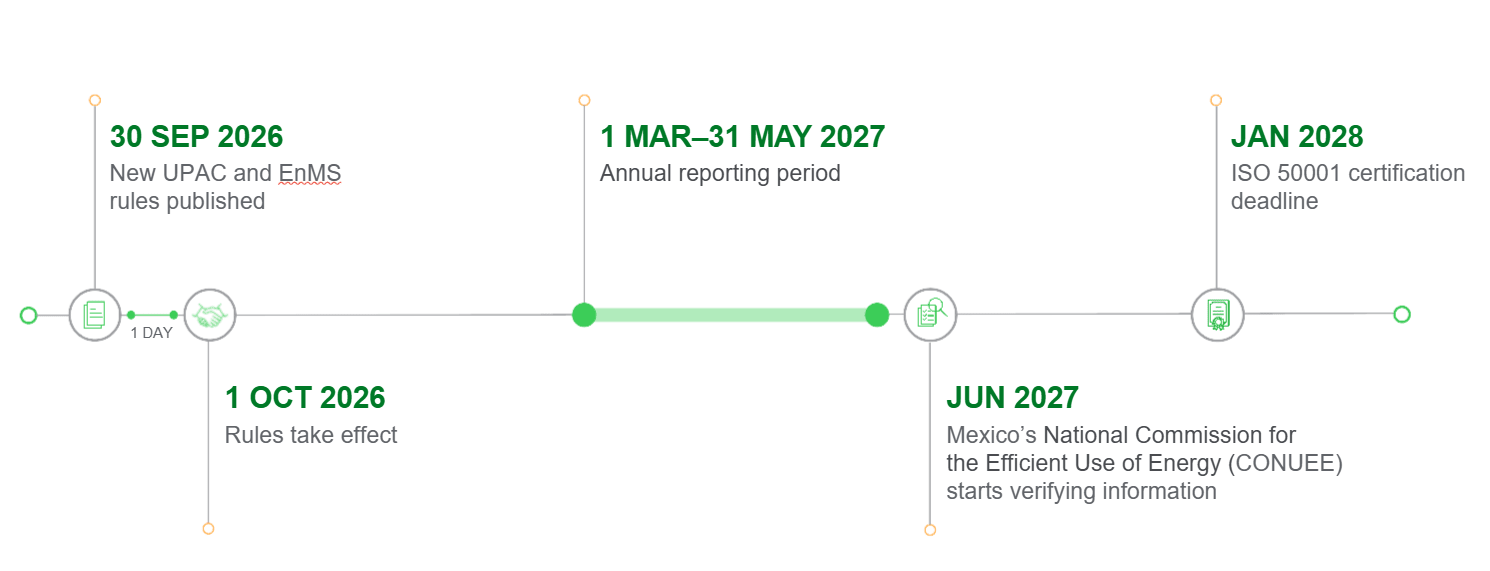
Companies essentially have just over a year from the effective date of the rules to prepare their EnMS for certification.
What should companies be reviewing now?
For organizations operating energy-intensive facilities in Mexico, the first step is to assess their current position against the new requirements.
Companies should consider:
- Do any of our facilities in Mexico exceed the UPAC thresholds?
- Do we have the energy and production data required for reporting, at the necessary level of detail?
- Do we have the right owners, KPIs, and processes in place to monitor energy performance and meet the reporting requirements?
- If a facility qualifies as a UPAC, how far are we from an ISO 50001-aligned EnMS and certification by the applicable deadline?
Answering these questions can help companies identify compliance gaps early and establish priorities for the implementation work ahead.
Moving from Compliance to Better Energy Management
An EnMS requires defined processes, responsibilities, KPIs, and mechanisms for continuous improvement. When implemented effectively, it can also help facilities improve energy performance, reduce operating costs, and lower emissions.
One of the most common barriers is fragmented energy data. When information is spread across multiple systems, sites, and spreadsheets, companies may struggle both to meet new reporting requirements and to consistently monitor energy performance.
Digitalizing energy information and management can help address this challenge by creating a consistent foundation for reporting and decision-making across facilities.
Software such as EcoStruxure™ Resource Advisor can help businesses:
- Unify and standardize energy data across multiple facilities and sources
- Reduce reliance on manual reporting and spreadsheets, making ongoing monitoring and reporting easier
- Compare facilities and identify efficiency opportunities to help prioritize resources
- Track KPIs and results to support investment decisions and replicate successful efficiency initiatives
- Enable the use of Artificial Intelligence by connecting data that is currently missing, unlocking new opportunities for optimization
.
.
From Compliance to Implementation
Technology addresses one part of the challenge. Companies also need to translate the regulatory requirements and ISO 50001 principles into processes that work within day-to-day operations.
SE Advisory Services, Schneider Electric’s global consulting practice, helps organizations assess readiness, implement ISO 50001-aligned energy management systems, digitize energy management, and establish continuous-improvement processes by combining consulting expertise, software, and implementation capabilities.
This approach draws on extensive experience in energy management and efficiency across both client projects and Schneider Electric’s own operations:
- $69 million in energy cost savings generated for clients in 2025 alone
- More than 1,150 client energy-efficiency projects completed
- Practical ISO 50001 experience within Schneider Electric’s own operations, with more than 126 ISO 50001-certified plants and a history as the first company globally to achieve ISO 50001 certification
Is Your Organization Ready?
If any of a company’s facilities in Mexico may qualify as a UPAC based on energy consumption, assessing their current readiness can help determine which requirements the facilities already meet and where further action is needed.
SE Advisory Services’ experts can help you assess your readiness against the applicable requirements and develop a roadmap for EnMS implementation and certification, bringing together consulting, digitalization, and energy-performance management experience.
Talk to an energy efficiency expert.
.
Contributor:
Leonardo Winzap
Leonardo leads energy management and efficiency consulting in Mexico for SE Advisory Services, Schneider Electric’s consulting practice. He brings international experience in energy efficiency and energy monitoring, gained through his work in Europe and Mexico.